Stainless steels like 304, 316L, and 317L have long been used across industries — but modern engineering demands more:
• Higher pressure
• Higher strength
• More corrosion resistance
• Longer service life
• Offshore & seawater compatibility
This is where Duplex (2205) and Super Duplex (2507 / S32760) outperform traditional stainless steels by a massive margin.
In this blog, we break down exactly why Duplex & Super Duplex steels offer superior strength, where they are used, and how they reduce failures in critical applications.

-
Call Us On
+91 97695 84950
-
Mail Us @
[email protected]
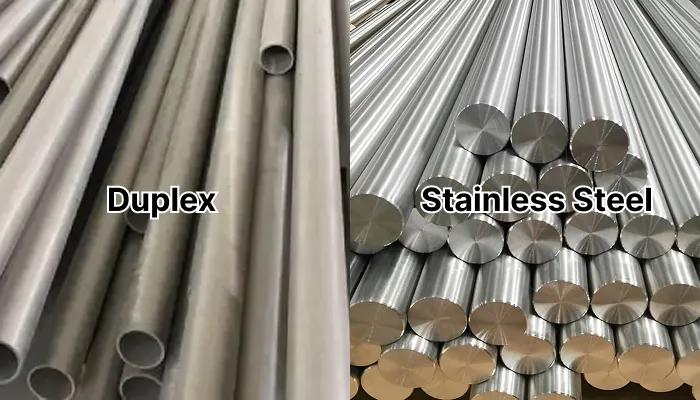
Duplex vs Stainless Steel Strength | 2025 Super Duplex Guide
Looking for a Reliable Metal Supplier?
Get premium quality pipes, sheets, and fittings delivered globally.
Yield Strength Advantage
Yield strength determines how much load a material can take before permanent deformation.
| Alloy | Yield Strength |
|---|---|
| 316L | 200–300 MPa |
| Duplex 2205 | 450 MPa |
| Super Duplex 2507 | 550 MPa |
📌 Duplex = 2X the yield strength of 316L
📌 Super Duplex = nearly 3X stronger
This strength is important for:
- High-pressure piping
- Structural offshore components
- Riser systems
- Subsea manifolds
Superior Fatigue Strength
Duplex steels resist vibration, cyclic loading, and dynamic stress better than 304/316.
Why?
Their ferrite + austenite microstructure absorbs energy and prevents crack propagation.
Used in:
- Pumps
- Turbines
- Offshore risers
- Ship propeller shafts
- Pulp & paper rotating equipment
Better Stress Corrosion Cracking Resistance
Austenitic stainless steels (304 / 316L) fail quickly when exposed to:
- Warm seawater
- Chlorides
- Tensile stress
Duplex steels have built-in immunity to SCC, especially Super Duplex 2507.
Impact Toughness
✔ Duplex 2205 — Good low-temperature impact performance.
✔ Super Duplex 2507 — High toughness + high strength, ideal for Arctic offshore platforms.
Where High Strength Matters Most
Industries relying on Duplex & Super Duplex strength:
- Oil & Gas Offshore Structures
- Desalination Plants
- Subsea Pipelines
- Chemical Processing Units
- Power Generation
- Water Treatment
- Marine Engineering
Components:
- Pressure vessels
- Heat exchangers
- Riser pipes
- Valves, pumps, and flanges
- Load-bearing offshore structures
Conclusion
Duplex and Super Duplex stainless steels offer unmatched strength, durability, and corrosion resistance.
Their ability to outperform 304/316 in harsh, high-pressure environments makes them the preferred choice for modern engineering projects in 2025.
For high-strength materials that deliver long-term reliability,
Moksh Tubes & Fittings LLP provides certified Duplex and Super Duplex pipes,
tubes, fittings, and custom fabrications.
Need Custom Dimensions or Rare Alloys?
We provide specialized fabrication, custom cutting, and export-grade packing globally. Request a quote or chat with our experts.
FAQ's
Why is Duplex stainless steel stronger than 304/316?
Because of its dual-phase microstructure (ferrite + austenite), which gives it double the strength and superior crack resistance.
Is Super Duplex stronger than Duplex?
Yes. Super Duplex 2507 has higher Chromium, Molybdenum, and Nitrogen, making it significantly stronger and more corrosion-resistant.
Can Duplex replace carbon steel in high-pressure systems?
Yes — especially where corrosion is present. Duplex steels offer high strength plus corrosion resistance, making them better than carbon steel.
How does temperature affect the strength of Duplex steels?
They retain good strength at high temperatures and excellent toughness at low temperatures, making them suitable for cold-climate offshore installations.
Why do offshore engineers prefer Super Duplex?
Because it offers: Extreme corrosion resistance Highest strength among stainless steels Long-term durability in seawater Excellent fatigue & SCC resistance
Recent Blogs
-
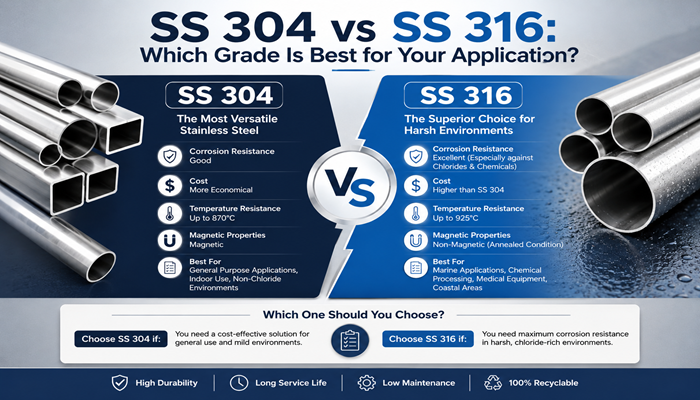
SS 304 vs SS 316: Which Grade Is Best for Your Application?
August 19, 2026
-
-
Locate Us
Office Address: Hinglaj Bhavan, Gulalwadi Mumbai, Maharashtra. 400004
Office Address: 6/A, Ground Floor, Rajwanti Mansion, Khetwadi Mumbai
Office Address: 95/95A, Dawood Baug, Sukhlaji Street, Kamatipura Mumbai
Office Address: 92E, Plot No. 3, New Tank Bunder, Darukhana, Mumbai, Maharashtra- 400 010.
get in touch
Let’s forge a connection — contact our team today.
Contact Us
At Moksh Tubes & Fittings LLP, we’re dedicated to making your purchases seamless — offering expert advice, a wide inventory of certified products, and global support for every order, large or small.
Get in Touch