Inconel alloys are some of the most trusted high-temperature materials used across aerospace, power generation, chemical processing, and oil & gas industries. Among these, Inconel 625 and Inconel 718 are two of the most frequently used superalloys because they offer exceptional strength, corrosion resistance, and performance under extreme temperatures.

-
Call Us On
+91 97695 84950
-
Mail Us @
info@mokshtubes.com
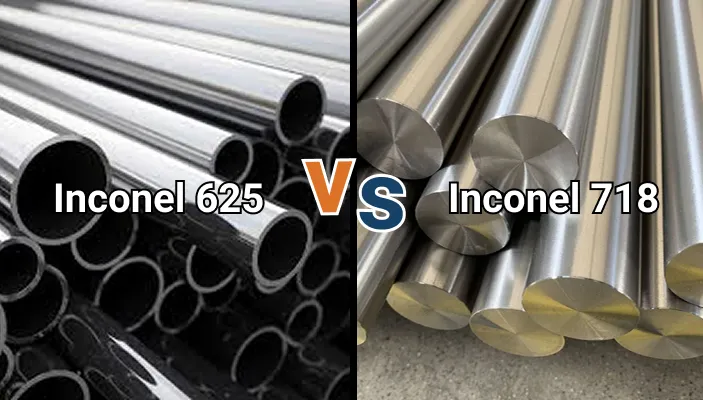
Inconel 625 vs Inconel 718: Detailed Comparison of Properties, Performance, and Applications
Overview: Inconel 625 vs Inconel 718
Inconel 625 (UNS N06625)
- Excellent corrosion resistance
- High strength without heat treatment
- Superb oxidation resistance
- Ideal for chemical, seawater, and high-temperature services
It is a solid-solution strengthened superalloy, meaning its strength comes from alloying elements, not heat treatment.
Inconel 718 (UNS N07718)
- Exceptional strength at high temperatures
- High creep resistance
- Superior fatigue and tensile performance
- Widely used in aerospace and turbine applications
Strength comes from Gamma Prime (γ′) and Gamma Double-Prime (γ″) precipitates after heat treatment.
Chemical Composition Comparison
Inconel 625 Composition
- Nickel: 58% min
- Chromium: 20–23%
- Molybdenum: 8–10%
- Niobium + Tantalum: 3.15–4.15%
- Iron: 5% max
Inconel 718 Composition
- Nickel: 50–55%
- Chromium: 17–21%
- Niobium: 4.75–5.5%
- Molybdenum: 2.8–3.3%
- Titanium & Aluminium (precipitation hardeners)
Key Difference:
- Inconel 625: Corrosion-focused alloy
- Inconel 718: Strength-focused alloy
Mechanical Properties 718 Is Much Stronger
Inconel 625 Mechanical Properties
- Tensile Strength: ~690 MPa
- Yield Strength: ~310 MPa
- Hardness: ~95 HRB
Inconel 718 Mechanical Properties
- Tensile Strength: 1275 MPa
- Yield Strength: 1035 MPa
- Hardness: 36–44 HRC
Conclusion: 718 is nearly 2x stronger due to precipitation hardening.
High-Temperature Performance
- Inconel 625: Up to 980°C for oxidation resistance
- Excellent for chemical plants
- Maintains strength at elevated temperatures
- Inconel 718: Best below 650°C
- Strength decreases above 650°C (precipitate instability)
- Excellent creep resistance under 650°C
Conclusion:
- 625 is better for extremely high temperatures (800–1000°C)
- 718 is better for high-strength applications below 650°C
Corrosion Resistance 625 Performs Better
Inconel 625 Corrosion Resistance
- Excellent resistance to seawater
- Strong resistance against chlorides
- Performs in acidic and alkaline media
- Resists oxidizing and reducing chemicals
Inconel 718 Corrosion Resistance
- Good overall corrosion resistance
- Not as strong as 625 in aggressive media
- Used where corrosion + high strength are both required
Conclusion:
- 625 is ideal for corrosion-heavy environments
- 718 is ideal for load-heavy environments
Weldability 625 Is Easier to Weld
- Inconel 625: Excellent weldability, no PWHT needed
- Ductile weld metal
- Inconel 718: Requires strict welding procedures
- Prone to cracking
- Needs post-weld heat treatment
Applications
Inconel 625 Applications
- Seawater piping
- Heat exchangers
- Chemical processing vessels
- Aerospace exhaust systems
- Furnace hardware
- Desalination plants
- Offshore riser systems
Inconel 718 Applications
- Jet engine components
- Turbine blades
- Rocket parts
- Downhole oilfield tools
- Fasteners
- High-temperature bolts
- Aerospace structural components
Comparison Table (Quick Reference)
| Property | Inconel 625 | Inconel 718 |
|---|---|---|
| Strength | Good | Excellent |
| Corrosion Resistance | Superior | Good |
| High-Temp Limit | 980°C | 650°C |
| Weldability | High | Moderate |
| Best For | Chemical, Marine | Aerospace, Power Gen |
Selection Guide
Choose Inconel 625 if:
- Superior corrosion resistance required
- Exposure to seawater or chemicals
- Operating temperatures above 650°C
- Weldability is important
- Easy fabrication preferred
Choose Inconel 718 if:
- Maximum strength needed
- Component faces extreme pressure
- Operating temperature below 650°C
- Aerospace or turbine application
- Fatigue resistance is critical
FAQ's
Which alloy is better for high heat?
Inconel 625 performs better above 700°C.
Which alloy is stronger?
Inconel 718 is significantly stronger under 650°C.
Can Inconel 625 be used in seawater?
Yes, 625 is one of the best seawater-resistant alloys.
Is Inconel 718 good for welding?
It requires controlled welding and heat treatment.
Which alloy lasts longer in chemical plants?
Inconel 625 lasts longer in chemical plants
Recent Blogs
-
Why Nickel Alloy Bars Are Used in High-Temperature Industries
December 11, 2025
-
-

Locate Us
info@mokstubes.com
Office Address: Hinglaj Bhavan, Gulalwadi Mumbai, Maharashtra. 400004
Office Address: 6/A, Ground Floor, Rajwanti Mansion, Khetwadi Mumbai
Office Address: 95/95A, Dawood Baug, Sukhlaji Street, Kamatipura Mumbai
Office Address: 92E, Plot No. 3, New Tank Bunder, Darukhana, Mumbai, Maharashtra- 400 010.
get in touch
Let’s forge a connection — contact our team today.
Contact Us
At Moksh Tubes & Fittings LLP, we’re dedicated to making your purchases seamless — offering expert advice, a wide inventory of certified products, and global support for every order, large or small.
Get in Touch