Welcome to Moksh Tubes & Fittings LLP

Monday - Friday : 8:00 AM to 7:00 PM

Seamless vs Welded Pipes – Which One Should You Choose in 2025? (Complete Buyer’s Guide)

Seamless vs Welded Pipes – Which One Should You Choose in 2025? (Complete Buyer’s Guide)

When engineers or buyers select piping materials for industrial projects, one question always creates confusion: “Should I use seamless pipes or welded pipes?”

Both types are widely used in oil & gas, chemical processing, power plants, fabrication, and structural industries—but each behaves differently under pressure, temperature, corrosion, and stress conditions. Choosing the wrong pipe can lead to failures, leaks, downtime, safety risks, and higher long-term costs.

This 2025 guide explains:

  • How they are manufactured
  • Where they should be used
  • Strength and pressure comparison
  • Cost difference
  • Corrosion resistance
  • Which pipe is best for your application

By the end, you’ll know exactly which pipe is right for your project.
What Are Seamless Pipes?

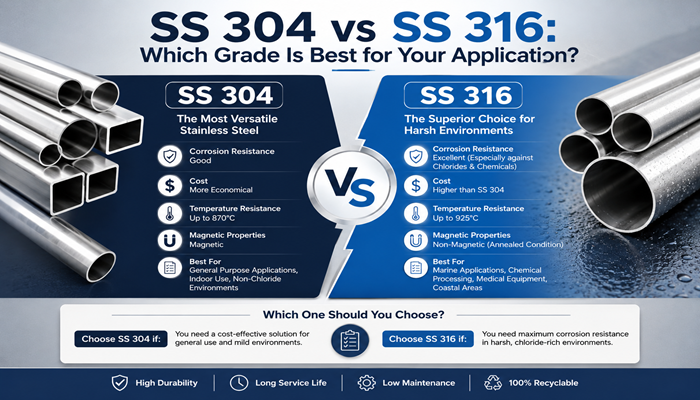
A seamless pipe is made from a solid round billet that is heated and pierced to create a hollow tube. There is no weld seam. No joint. No weak point.

Why does this matter?

  • Strength becomes uniform
  • Pressure tolerance increases
  • Failure risk reduces
  • Pipe becomes more reliable in extreme environments

This is why seamless pipes are preferred for critical, high-pressure, high-temperature operations.

Applications of Seamless Pipes

High Pressure Systems

  • Boilers
  • Superheaters
  • Heat exchangers
  • High-pressure steam lines
  • Hydraulic & pneumatic systems

High Temperature & Corrosive Environments

  • Chemical & petrochemical plants
  • Oil & gas production
  • Refineries
  • Fertilizer plants
  • Subsea operations

Precision Engineering

  • Automotive cylinders
  • Mechanical components
  • Heavy machinery

Summary: For strength, safety, and reliability, seamless pipes are the superior choice.

What Are Welded Pipes?

Welded pipes are made by rolling a metal strip and welding the edges together to form a pipe.

Modern welding technologies include ERW, HFW, SAW, EFW.

Advantages of Welded Pipes

  • More affordable than seamless
  • Easier to produce in large quantities
  • Available in very large diameters
  • Uniform wall thickness
  • Smooth and clean surface finish
  • Suitable for structural and low/medium pressure use

Applications of Welded Pipes

Low & Medium Pressure Uses

  • Water pipelines
  • Firefighting systems
  • Low-pressure steam
  • HVAC systems

Large Diameter Requirements

  • Water distribution
  • Oil transportation lines
  • Structural supports

General Industrial Uses

  • Construction & fabrication
  • Automobile industry
  • Infrastructure projects

Summary: For cost-efficiency, large diameters, and standard pressure, welded pipes are the better option.

Manufacturing Process Comparison

How Seamless Pipes Are Manufactured

  • Billet cutting
  • Heating
  • Piercing
  • Rolling
  • Heat treatment
  • Straightening
  • Testing

Result: A strong, joint-free pipe with uniform strength.

How Welded Pipes Are Manufactured

  • Coil/strip slitting
  • Forming
  • Welding
  • Heat treatment
  • Expansion
  • Surface finishing
  • Testing

Result: A highly accurate pipe with consistent thickness.

Strength & Pressure Comparison

Property Seamless Pipe Welded Pipe
Pressure Strength Higher Medium
Temperature Resistance Higher Medium
Weld Weakness None Present at seam
Dimensional Accuracy Medium Higher
Large Diameter Availability Limited Excellent
Cost Higher More Affordable

Verdict: For pressure & temperature → Seamless. For cost & diameter → Welded.

Corrosion Resistance

Corrosion resistance does not depend on whether the pipe is seamless or welded. It depends on:

  • Material grade (SS, Duplex, Nickel Alloys)
  • Chemical environment
  • Temperature
  • Chloride level
  • Media (liquid, gas, slurry)

Welded pipes can corrode faster at the weld zone if not heat-treated properly. Seamless pipes eliminate this risk.

Cost Comparison

Seamless Pipes Cost More Because:

  • Complex manufacturing
  • Higher testing requirements
  • Higher strength & pressure ratings

Welded Pipes Are More Affordable Because:

  • Faster production
  • Less material wastage
  • Lower processing costs

Average Price Difference: Seamless pipes are 30–40% costlier (varies by size, grade, schedule, market).

Which Pipe Should You Choose?

Choose Seamless Pipes If:

  • High pressure
  • High temperature
  • Boiler/heat exchanger application
  • Corrosive media
  • Safety-critical plant
  • Long-term reliability needed

Choose Welded Pipes If:

  • Budget is limited
  • Large diameter is required
  • Low/medium pressure service
  • Water/structural pipelines
  • Fast delivery needed

Common Mistakes Buyers Make

  • Mistake 1: Choosing welded pipes for high-pressure boilers.
  • Mistake 2: Selecting seamless pipes for low-pressure water lines.
  • Mistake 3: Ignoring heat treatment on welded pipes.
  • Mistake 4: Buying from non-certified suppliers — MTC 3.1 is mandatory.

Conclusion

Both seamless and welded pipes are valuable in industrial applications — what matters is choosing the right one for your project’s pressure, temperature, corrosion, and budget requirements.

Seamless = Strength + High Pressure + High Temperature

Welded = Cost Effective + Large Diameter + Standard Pressure

FAQ's

Are seamless pipes always better?

No. They are better for high pressure and temperature. For standard applications, welded pipes are perfect.

Are welded pipes safe?

Yes. Modern welding makes welded pipes very reliable.

Which pipe is cheaper?

Welded pipes are 30–40% cheaper.

Do you provide MTC 3.1?

Yes, Moksh Tubes provides MTC 3.1, 3.2, and all documents.

What sizes are available?

From 1/4" to 48" depending on seamless or welded types.

Contact Us

At Moksh Tubes & Fittings LLP, we’re dedicated to making your purchases seamless — offering expert advice, a wide inventory of certified products, and global support for every order, large or small.

Get in Touch