Welcome to Moksh Tubes & Fittings LLP

Monday - Friday : 8:00 AM to 7:00 PM

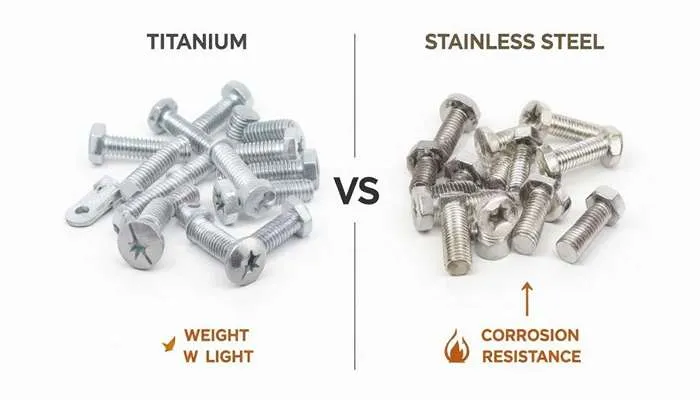
Titanium vs Stainless Steel – Strength, Weight & Cost Comparison (2025 Engineering Guide)

Titanium vs Stainless Steel – Strength, Weight & Cost Comparison (2025 Engineering Guide)

Titanium and stainless steel are two of the most widely used engineering materials across global industries. Both provide high strength, durability, corrosion resistance, and structural performance—but the differences between them make each suitable for different applications.

Industries such as aerospace, marine, medical, nuclear, oil & gas, chemical, and high-performance engineering rely on the correct material for:
  • Safety
  • Cost efficiency
  • Weight reduction
  • Corrosion prevention
  • Lifespan
  • Performance

This expert guide from Moksh Tubes & Fittings LLP explains:

  • Full comparison of titanium vs stainless steel
  • Strength, weight, corrosion & heat resistance
  • Industrial applications
  • Cost comparison
  • Selection guide
  • FAQs
  • Why Moksh is a trusted global supplier

Chemical Composition — The Foundation of Differences

Titanium (Pure & Alloy Grades)

  • Pure titanium (Grades 1–4)
  • Alloys (Grades 5, 7, 9, 12)
  • Alloying elements: Aluminum, Vanadium, Molybdenum, Tin, Palladium
  • Lighter, more corrosion-resistant, biocompatible

Stainless Steel

  • Iron-based alloy with 10–20% Chromium
  • Popular grades: 304, 316L, 321, 347, Duplex 2205, Super Duplex
  • Heavier but economical and strong at lower temperatures

Strength Comparison

Material Tensile Strength
Titanium Grade 2~345 MPa
Titanium Grade 5 (Ti-6Al-4V)~895 MPa
Stainless Steel 304~515 MPa
Stainless Steel 316L~485 MPa
Duplex 2205~620–800 MPa
  • Titanium Grade 5 is stronger than most stainless steels
  • Duplex stainless steels can match or exceed some titanium grades

Winner: Depends on grade

  • Pure titanium < Stainless steel
  • Titanium alloys (Grade 5, 23) > Stainless steel

Weight Comparison — Titanium Wins

Material Density (g/cm³)
Titanium4.5
Stainless Steel7.8

Titanium is 45% lighter than stainless steel.

Why weight matters:

  • Aerospace → major fuel savings
  • Automotive → performance & efficiency
  • Medical implants → patient comfort
  • Marine → better buoyancy
  • Structural engineering → reduced load

Winner: Titanium

Corrosion Resistance Comparison

Titanium

  • Exceptional corrosion resistance
  • Strong TiO₂ protective layer
  • Resistant to chlorides, seawater, acids, hypochlorites, wet chlorine gas

Stainless Steel

  • Good general resistance
  • 304/316L work in mild environments
  • Susceptible to pitting, crevice corrosion, chloride attack, SCC
  • Duplex improves performance but still below titanium

Winner: Titanium

Heat Resistance Comparison

Titanium

  • Withstands 400–600°C depending on grade
  • Grade 5 maintains strength at 400°C

Stainless Steel

  • 304/316L up to ~550°C
  • 321/347 improved heat resistance
  • 310S withstands 1000°C
  • Duplex only up to ~300°C

Winner: Stainless Steel (for temperatures above 700°C)

Winner: Titanium (for heat + corrosion environments)

Fatigue Strength Comparison

Titanium has extremely high fatigue strength due to:

  • Low modulus
  • Strong oxide film
  • Stable microstructure

This is why titanium is preferred for:

  • Aircraft wings
  • Offshore components
  • Medical implants
  • High-performance sports equipment

Winner: Titanium

Cost Comparison

Material Cost
Titanium$$$$
Stainless Steel$$

Titanium is 4–10× more expensive due to extraction difficulty, refining complexity, and manufacturing cost.

Winner: Stainless Steel

Machinability, Fabrication & Weldability

Titanium

  • Difficult to machine
  • Needs specialized tools
  • Challenging to weld (requires inert gas shielding)

Stainless Steel

  • Easy to machine
  • Easy to weld
  • Widely fabricated

Winner: Stainless Steel

Applications — Where Each Material Performs Best

Titanium Applications

  • Aerospace: Jet engines, fuselage structures, landing gears
  • Marine: Heat exchangers, seawater piping, condenser tubes
  • Medical: Implants, surgical instruments
  • Oil & Gas: Offshore risers, high-pressure tubing
  • Chemical: Chlorine systems, acid-resistant reactors

Stainless Steel Applications

  • Architecture: Railings, structural components
  • Chemical Plants: Storage tanks, pipelines
  • Food & Pharma: Hygienic equipment
  • Automotive: Exhaust systems
  • Power Plants: Boilers, heat exchangers

Titanium vs Stainless Steel — Quick Selection Guide

Requirement Best Material
LightweightTitanium
High corrosion resistanceTitanium
Low costStainless Steel
Easy fabricationStainless Steel
Chlorides / seawaterTitanium
Medical implantsTitanium
High heat >700°CStainless Steel
High fatigue loadingTitanium

FAQ's

Which is stronger, titanium or stainless steel?

Titanium Grade 5 > Stainless steel 304/316. But Duplex stainless steel can match titanium strength at room temperature.

Why is titanium so expensive?

Complex extraction, low abundance, and processing challenges.

Is titanium better for corrosion resistance?

Yes, much better than stainless steel.

Is stainless steel better for high heat?

Yes, certain grades can withstand up to 1000°C.

Which is better for structural components?

Titanium for weight + strength Stainless steel for cost + fabrication ease

Contact Us

At Moksh Tubes & Fittings LLP, we’re dedicated to making your purchases seamless — offering expert advice, a wide inventory of certified products, and global support for every order, large or small.

Get in Touch