Welcome to Moksh Tubes & Fittings LLP

Monday - Friday : 8:00 AM to 7:00 PM

What Is a Metal Coil? Types, Processing Methods & Common Uses

What Is a Metal Coil? Types, Processing Methods & Common Uses

Metal coils are one of the most widely used raw materials in industries like Automotive, Construction, Appliances, Oil & Gas, Piping Systems, Manufacturing, HVAC, and Fabrication.

But many people still get confused about:

  • πŸ‘‰ What exactly is a metal coil?
  • πŸ‘‰ How is it made?
  • πŸ‘‰ Why do industries choose coils over sheets?
  • πŸ‘‰ What are the different types of coils?
  • πŸ‘‰ Which coil is best for which application?

This guide explains everything in simple, beginner-friendly English.
What Is a Metal Coil? (Very Simple Explanation)

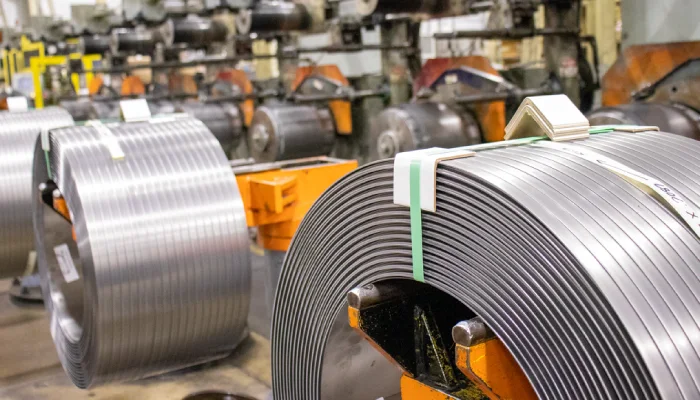
A metal coil is a long sheet of metal rolled into a large spiral form β€” like a long metal ribbon.

Metal coils are produced by rolling slabs into thin sheets using heavy rolling mills.

Why are coils used instead of sheets?

  • Easy to transport
  • Can be cut to any length
  • Perfect for large production
  • Saves storage space
  • Ideal for automated cutting machines

Types of Metal Coils (Most Common in 2025)

1. Hot Rolled Coil (HRC)

Made by rolling steel at high temperature.

Characteristics

  • Rough finish
  • Lower cost
  • Good strength

Best For:

  • Structural work
  • Fabrication
  • Heavy machinery

2. Cold Rolled Coil (CRC)

Made from HRC but processed again at room temperature.

Characteristics

  • Smooth finish
  • High accuracy
  • Higher strength

Best For:

  • Automotive
  • Appliances
  • Precision parts

3. Galvanized Coil (GI)

Coated with zinc for corrosion resistance.

Best For:

  • Roofing
  • HVAC
  • Exterior applications

4. Galvalume Coil (GL)

Coated with zinc + aluminium.

Best For:

  • Coastal areas
  • High-corrosion zones

5. Stainless Steel Coil

Made from SS 304, 316, 321, Duplex etc.

Best For:

  • Food industry
  • Pharma
  • Chemicals
  • Decorative panels

6. Aluminum Coil

Lightweight and corrosion-resistant.

Best For:

  • Heat exchangers
  • Automotive
  • HVAC fins

Metal Coil Manufacturing Process

There are three main stages:

Stage 1 β€” Hot Rolling

Steel slab β†’ Heated β†’ Passed through rollers β†’ Becomes long sheet β†’ Rolled into HRC coil.

Stage 2 β€” Pickling (optional)

Removes scale, rust, impurities.

Stage 3 β€” Cold Rolling

HRC passed into cold rolling mill for precision β†’ becomes CRC.

Surface / Finished Coils

  • Galvanizing
  • Annealing
  • Polishing
  • Coating

Coil Processing Methods (Industry Standard)

  • 1. Slitting: Cuts coil into narrow strips.
  • 2. Cut-to-Length: Produces sheets from coils.
  • 3. Re-Coiling: Rewinds into smaller coils.
  • 4. Polishing: For stainless steel coils.
  • 5. Coating: Zinc, galvanizing, color coating.
  • 6. Embossing: Creates textured patterns.

Advantages of Using Metal Coils

  • Economical for bulk production
  • Can be cut to any size
  • Saves storage & space
  • Perfect for continuous lines
  • Lower material wastage
  • Easy transportation
  • Suitable for automation

Common Uses of Metal Coils (Industry-Wise)

1. Construction & Roofing

  • Roofing sheets
  • Wall cladding
  • Decking sheets
  • Uses GI / GL coils.

2. Automotive Industry

  • Car body parts
  • Structural panels
  • Interior components
  • Uses CRC / Aluminum coils.

3. Appliances

  • Refrigerators
  • Ovens
  • Washing machines
  • Uses stainless & CRC coils.

4. Oil & Gas / Chemical Plants

  • Tanks
  • Heat exchanger sheets
  • Pressure components
  • Uses SS, Duplex, Nickel coils.

5. Fabrication Workshop

  • Laser cutting
  • Bending
  • Punching
  • Coils supply raw sheet metal.

6. HVAC Systems

  • Ducts
  • Fins
  • Housings
  • Uses aluminum / galvanized coils.

How to Choose the Right Coil for Your Application?

  • βœ” For high precision β†’ CRC
  • βœ” For corrosion resistance β†’ GI / GL
  • βœ” For food & pharma β†’ SS 304/316 coils
  • βœ” For high temperature β†’ SS 310S / Inconel coils
  • βœ” For marine β†’ GL / SS 316
  • βœ” For automotive β†’ CRC / Aluminum

Still confused? Moksh Tubes provides coil selection support.

Why Moksh Tubes Is a Trusted Supplier of Metal Coils

  • Hot Rolled, Cold Rolled, GI, GL, Stainless Steel & Nickel Coils
  • Thickness: 0.3 mm to 20 mm
  • Width: 100 mm to 1500 mm
  • Coil slitting & cut-to-length service
  • Polished coils (No.4, No.8, Matte, Hairline)
  • Ready stock & global shipping
  • MTC 3.1 / 3.2 certification

Conclusion

Metal coils are the backbone of modern manufacturing, thanks to their easy handling, custom length options, cost-effectiveness, and compatibility across industries.

Whether you need HRC, CRC, GI/GL, Stainless Steel, or Nickel Alloy coils, Moksh Tubes provides certified, high-quality materials with tailored sizing solutions.

FAQ's

Which coil is best for roofing?

Galvanized (GI) or Galvalume (GL).

Are coils cheaper than sheets?

Yes β€” more efficient for large production.

Which coil is used in the chemical industry?

Stainless steel & nickel alloy coils.

Do you supply cut-to-length sheets?

Yes β€” customized cutting available.

Contact Us

At Moksh Tubes & Fittings LLP, we’re dedicated to making your purchases seamless β€” offering expert advice, a wide inventory of certified products, and global support for every order, large or small.

Get in Touch