High Strength Stainless Steel (HSSS) Guide 2026: Grades, Properties & Applications
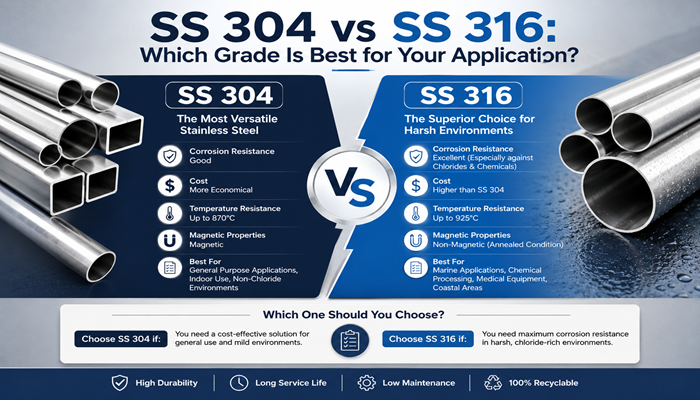
Stainless steel is widely known for its corrosion resistance, but modern industries now demand extreme strength, superior fatigue resistance, and long-term durability—where standard grades like 304 and 316 are no longer sufficient.
This is where High Strength Stainless Steels (HSSS) play a critical role.
In 2026, these advanced materials are engineered to perform in extreme environments across aerospace, defence, oil & gas, petrochemical, marine, automotive, and heavy engineering industries.
These steels are designed to deliver:
- Very high tensile strength
- Excellent corrosion resistance
- High fatigue and wear resistance
- Improved machinability (depending on grade)
- Stable performance in harsh and high-pressure environments
What Makes Stainless Steel “High Strength”?
Stainless steel achieves high strength through advanced metallurgy and processing techniques:
- Alloying elements: nickel, chromium, molybdenum, copper, niobium, vanadium, nitrogen
- Heat treatments: aging, solution annealing, precipitation hardening, tempering
- Martensitic transformation
- Precipitation hardening (PH) mechanisms
These enhancements significantly improve mechanical strength, hardness, and resistance to deformation under stress.
Types of High Strength Stainless Steel
Martensitic High Strength Stainless Steels
- Magnetic
- Heat-treatable
- Very high strength
- Moderate corrosion resistance
Examples: 410, 420, 440A/B/C, 431
Precipitation Hardening (PH) Stainless Steels
- Best balance of strength and corrosion resistance
- Widely used in aerospace, marine, and defence
Popular Grades: 17-4 PH, 15-5 PH, 13-8 Mo
High-Nitrogen & Duplex-Based High Strength Steels
- Excellent combination of strength and corrosion resistance
- Ideal for marine and offshore environments
Examples: Super Duplex 2507, Lean Duplex 2101
Popular High Strength Stainless Steel Grades
17-4 PH Stainless Steel
- Tensile strength: ~1310 MPa
- Yield strength: ~1170 MPa
- Excellent fatigue resistance
Applications: Aerospace fittings, valves, pump shafts
15-5 PH Stainless Steel
- Improved toughness compared to 17-4 PH
- Better uniform mechanical properties
Applications: Aerospace components, marine hardware
13-8 Mo Stainless Steel
- Superior toughness and strength
- High resistance to stress corrosion cracking
Applications: Aerospace fasteners, high-performance shafts
440C Stainless Steel
- Very high hardness and wear resistance
Applications: Bearings, valve parts, cutting tools
431 Stainless Steel
- High strength alternative to 304/316
- Good corrosion resistance
Applications: Shafts, marine fasteners
Super Duplex 2507
- Tensile strength: 750–860 MPa
- Excellent resistance to chloride corrosion
Applications: Offshore piping, subsea equipment
Mechanical Properties of High Strength Stainless Steel
- Tensile strength: 600–1500 MPa
- High fatigue life under cyclic loading
- Hardness up to ~60 HRC
- Excellent wear and abrasion resistance
Corrosion Resistance Performance
- Superior corrosion resistance compared to carbon steels
- PH grades resist chloride stress corrosion cracking
- Duplex and super duplex steels perform well in seawater
- Martensitic grades may require coatings in aggressive environments
Industrial Applications of High Strength Stainless Steel
- Aerospace: Landing gear, turbine blades, structural components
- Oil & Gas: Downhole tools, valves, pressure systems
- Chemical Processing: Reactors, pump shafts
- Marine: Propeller shafts, subsea fittings
- Automotive: Gears, suspension systems
- Food Processing: Wear-resistant machinery
High Strength Stainless Steel vs Regular Stainless Steel
| Property | Regular SS (304/316) | High Strength SS |
|---|---|---|
| Strength | Low–Medium | High–Very High |
| Hardness | Soft–Medium | Medium–High |
| Wear Resistance | Moderate | Strong |
| Heat Treatment | Not hardenable | Hardenable |
| Corrosion Resistance | High | Grade-dependent |
| Price | Lower | Higher |
Advantages of High Strength Stainless Steel
- High load-bearing capacity
- Excellent fatigue resistance
- Suitable for extreme environments
- Long service life and durability
- Good corrosion resistance across multiple grades
Limitations
- Higher material and processing cost
- More complex machining and fabrication
- Some martensitic grades may be brittle
- Certain grades may have lower corrosion resistance than 316
How to Choose the Right High Strength Stainless Steel (2026 Guide)
✔ Aerospace: 15-5 PH, 13-8 Mo
✔ Petrochemical: 17-4 PH
✔ Marine & Offshore: Super Duplex 2507, 431
✔ Wear Resistance: 440C
✔ Shaft Applications: 431, 17-4 PH
✔ General Engineering: 17-4 PH or 15-5 PH
Conclusion
High Strength Stainless Steels are no longer niche materials—they are essential engineering solutions in 2026.
They provide:
✔ Superior strength and durability
✔ Resistance to extreme stress and fatigue
✔ Reliable performance in harsh environments
✔ Long-term cost efficiency through reduced failure
Understanding these advanced materials helps engineers and buyers select the right grade for high-performance applications.
With Moksh Tubes, you get access to premium-quality high strength stainless steels tailored for modern industrial demands.